Jumat, 24 April 2015

One Word: Vocab in Context Mystery

Earlier this week, I was asked on Voxer by California colleague Beth Oing if I knew what "oam" means in Book IV of Samuel Butler's translation of The Odyssey.   The understanding of the meaning of this one three letter word has sparked a journey of discovery spanning across various states and social media.


Here is the passage in question, as captured from The Internet Classics Archive:


In context, Helen is stating that during this time in the Trojan War she has begun to yearn or long for home.  But why didn't Butler just use the words "yearn" or "long"? There has to be a particular reason for that particular word. If readers understand "oam", will we see something more into Helen's character and mindset during this period?

Refiling through my Latin dictionary, I didn't recognize "oam" and assumed,  since I'm not versed in Greek, that "oam" must be some sort of play on words and Butler was using a Greek word as a pun. But why would there be a Greek word mixed in with the Latin names of Ulysses and Menelaus?  That didn't make sense either.

Carrying the conversation over to Twitter, I consulted 2014 Indiana State Teacher of the Year and Latin teacher Steve Perkins....


Thinking about diction and author's purpose, the literal English translation of the Greek as "her heart has turned to go toward home." By stating that Helen's heart had "turned" toward home, it implies that at one point she had turned away from home.  So the mystery of the Rape of Helen -- whether she went willingly with Paris or was forcibly kidnapped-- seems to have an answer in Homer: Helen wanted to go with Paris!  Could the word "oam" in Butler's translation signify this as well?  But then why didn't Butler use the literal translation? I love reading The Odyssey with my students for so many reasons, but being able to explore word choice in the various translations (Lattimore is still my favorite) and discuss how individual words can shape the meaning has taught my students that words do matter!


Still not satisfied, Steve then broached the topic with contacts via email and  his Latin educators group on Facebook....


Did you catch that??? Steve's friend at Cambridge looked at THE Butler manuscripts. Talk about consulting the source!  This is like six degrees of separation-- with a few tweets, emails, and posts we were able to find a scholar with access to an original document to guide our understanding.  What else can we research?! 


This has be such an engaging and fun use of modern social media to solve an ancient mystery. I echo Mr. Steve Perkins' sentiments!

I contacted the Classics professor at my local university, but we still haven't come upon an answer for oam.


The mystery continues!  


Jumat, 17 April 2015

Happy Telemachus Appreciation Day!

I LOVE it when students are just as nerdy as I am.

Last year reading Homer's Odyssey and watching the 1997 made-for-TV movie starring Armand Assante, a trio of students were so intrigued (read: obssessed) with Odysseus' son Telemachus, that they tracked down the actor, Alan Stenson, who played him in the film, created fan club t-shirts (including one for me!), and shared pictures of the us wearing the shirts via social media, declaring themselves "Stensonites."


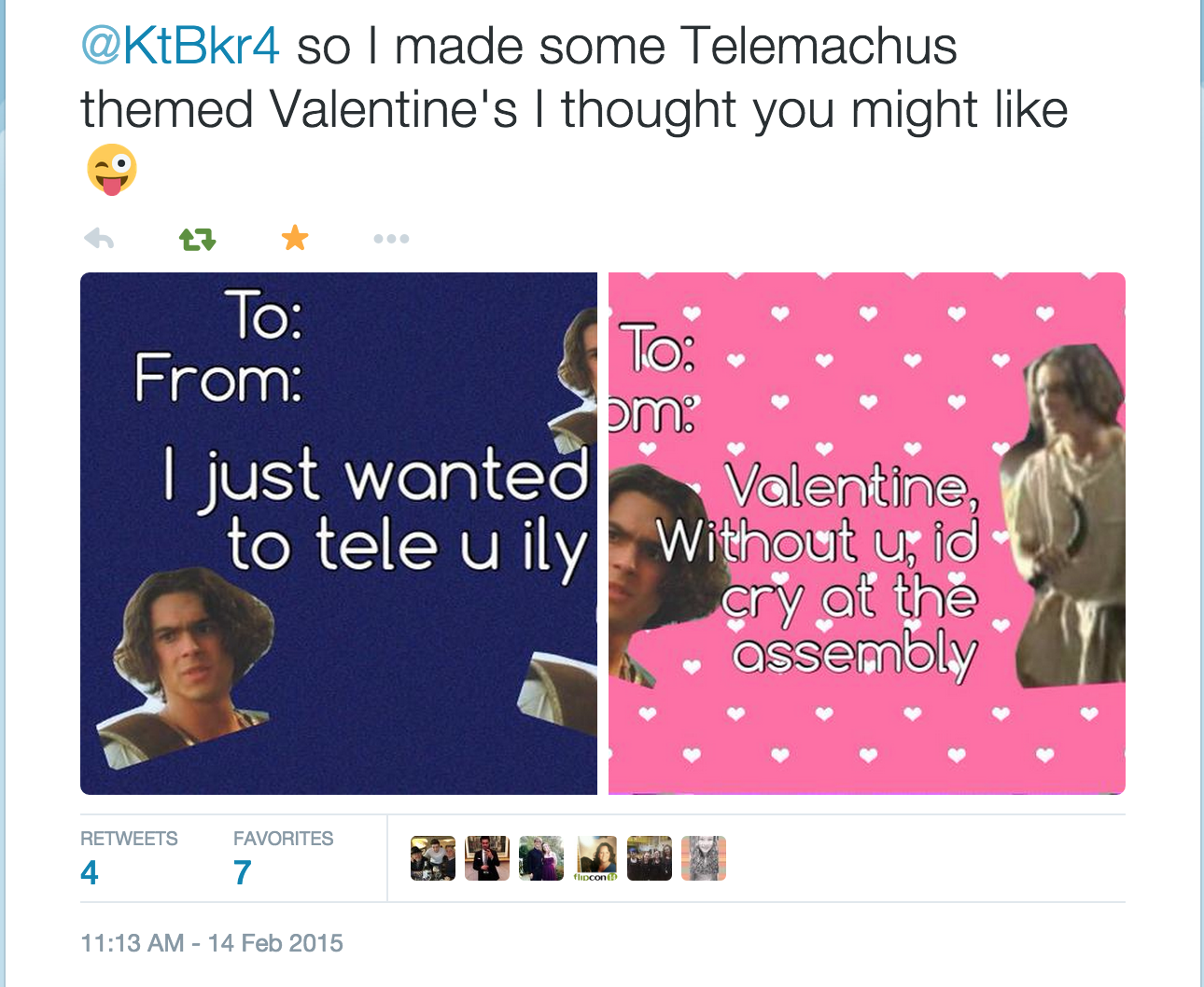
And if that wasn't enough, almost a year later on Valentine's Day, one of these same students sent me Telemachus themed valentines via Twitter and, of course, tweeted them to Mr. Stenson.


So here we are, April 17th, and this year's crop of students are reading/watching The Odyssey, and in honor of seeing Telemachus projected on the screen in my room, my wonderfully nerdy former students deemed today "Telemachus Appreciation Day."


My current senior students aren't as impressed with our nerdiness, but one joined the fun, tweeting...


So in honor of Telemachus Appreciation Day, we wore our shirts again...


And tweeted more pics to Alan Stenson....


Thank the gods, actor Alan Stenson is a good sport!


Senin, 09 Maret 2015

Reading for the Jaded Student & All: Curriculet partners with USA Today

I'm super stoked for today's announcement from Curriculet.

Curriculet has proven its worth and merit as I flip summer and independent reading, PARCC prep, and novel studies. Building on what they already do well--creating authentic reading experiences for students and behind the scenes data for teachers to use to drive instruction--  Curriculet is announcing a partnership with USA Today:

"Now, students and teachers can access relevant and timely news from USA TODAY through Curriculet's dynamic reading platform. In addition to its free on-demand digital library filled with popular books, Curriculet now allows students to read news articles with embedded assessments that develop literacy skills and build subject area knowledge. Known as "curriculets," these integrated checkpoints focus on specific skills and Common Core Standards.

Every day, Curriculet delivers articles curated for classrooms and pre-loaded with interactive layers of instruction that include annotations, rich media and question sets. Every article includes three differentiated layers targeted to elementary, middle and high school reading levels so that each student can interact with the text.

Curriculet’s real-time reporting feature lets teachers track student achievement in every assignment. Teachers can assess progress on standards and literacy skills, track time spent on-task, and identify where individual learning gaps are.
 
Whereas other news services for students offer outdated news stories, Curriculet’s partnership with USA TODAY makes it possible to supply students with articles the day after publication, in their original form."

Here's why I am excited about this announcement:  Curriculet is providing me with another way to reach struggling readers and jaded students.  To be honest, I'm not worried about my Honors students-- they will read whatever I give them--but, I'm worried about getting and keeping my lower-level freshmen and disaffected seniors reading. Asking them to sustain their attention for a whole novel is a Herculean feat. They often give up before they ever get started, intimidated by the length and preconceived notions about reading for class. But reading one, heck, even two short, high-interest articles a day (and answering a few questions and clicking on a few annotations) will build a daily habit for reading because they can do it.

Curriculet's partnership will enable me to give my students relevant and current SHORT reading pieces that appeal to their interests AND provides me with data on their skills--and I don't have to do any extra work. Like reading the newspaper, I can keep my students up to date on current events, sports, national news, international events, and my favorite category, "Good News" featuring positive focused human interest stories.
Selection of articles updated daily with older ones still available.

My seniors who usually fight me on EVERYTHING I ask them to do can't complain about reading a short article.  My reluctant freshmen who don't feel like they are competent readers can feel competent with Curriculet. There's no harm; there's nothing to fear.  High interest, appropriate reading level-- read it, enjoy it, and answer a few questions for me...  nothing too arduous.  And since each article targets one specific Common Core Standard at a time, I can keep an eye on their skills and alignment to the standards with little effort on my part.

Data on student reading performance:
available by student & question
Beta-testing the USA-Today feature two weeks ago, it was seamless to choose articles and assign them to my students. Clicking on USA Today in the navigation ribbon, I selected and assigned texts the same way as I normally do in Curriculet.   Since the students are already familiar with reading via Curriculet, it didn't seem like anything new to them either. I started off with articles on Mars exploration, high school basketball, and the movie American Sniper.

Whole class progress bar for easy viewing

In each of my 5 classes the same thing happened each day: my better-performing, compliant students got started right away, opened the articles, and I listened to them chat with their neighbors... "Hey, this is cool what the team did for this girl. Reminds me of the Challenger League we have here at Southern... Oh, I want to see that American Sniper movie...  Wow, it is based on a true story?... Whoa they showed this movie in Baghdad? People had to freak!... What?1 There was a contest to go to Mars? That is crazy!... I think it would be cool to be part of that...No way dude, I'm happy here on Earth." 

From the article, What moviegoers in Baghdad think of American Sniper,
students answer questions embedded in the text.

Overhearing the conversations, my lower-performing, not-always-compliant students were intrigued and, not wanting to miss out, opened Curriculet and started reading. I circulated around the room checking in with groups of students and then called the class together for a wrap up discussion. We talked about perspective and audience perception, inclusion of special needs folks, and setting and achieving long term goals.  All of that was accomplished with three short, nonfiction articles. On days two and three of our beta-testing, I didn't need to prod any students to get started, they jumped right into reading new articles and we had a repeat of engaging class discussions.  The positive energy carried into the rest of the period as we switched to reading Hamlet (seniors) or The Odyssey (also in Curriculet).

I really like that I'm not sending my students to another site for nonfiction, digital reading.  Within Curriculet, students can read anything and everything from contemporary YA lit novels from publishers to canonical texts to documents I upload to current nonfiction articles.  With its broad service offerings, Curriculet once again proves to me that is the only digital reading tool I need to get all my students reading.

I envision using the Curriculet-USA Today articles as a daily Do Now/Bell Ringer activity for all of my classes. Students enter the classroom, grab a Chromebook or sign on their smartphones and spend the first few minutes of class reading, answering questions, and discussing the articles with their neighbors. We could continue to do a quick round-robin discussion of the articles and what they found interesting in each. Students are staying informed on current events AND demonstrating valuable life reading skills.

There are so many MORE activities I could do with Curriculet & USA Today!
I'd love to read about your ideas, too. Please comment and share!


Minggu, 08 Maret 2015

Literally Up in the Air with Google Cloud Printing

So I am on my way to the #SxSWEdu conference and I'm typing this post while sitting in seat 34C on a Delta airplane.  In the mad dash to get out of the house on time (ugh, 5:30 am), I didn't have a chance to write up information about family schedules and lunches for my husband who will be running the show while I'm gone.

I splurged ($16) for the Go-Go Inflight wifi access, and thank heavens I did! Working on the plane, I typed up the schedule and notes for school in a Google Doc, shared it with my husband so he could read it on his phone, and sent the doc to our home printer on which I had previously set up the Google Cloud Printing services.  With a quick text message to my husband to make sure the printer was turned on, I sent it off from 10,000 feet in the air. And, wa-la, magically the document was printed!

Google Cloud Printing is literally a life saver helping to make sure things run smoothly at home.


Senin, 23 Februari 2015

#Flipclass Flashblog: Deeper Learning w The Odyssey

February is Odyssey time for my students.  I have been teaching Homer's Odyssey for every year of my career, even during student teaching.  If there is a text to dive into deeply, this is it.  There are so many topics I cover with this epic.

To name a few...


  • Joseph Campbell's Hero Journey-- students analyze how both Odysseus and Telemachus undergo a heroic transformation
  • Oral storytelling techniques-- Trojan War Stories, Odysseus' guest-gift of the story of his journey to the Phaiakians
  • Persuasive techniques-- compare and contrast Telemachus' speech at the Assembly (Book 2) with Athena's request to Zeus during the Council of the Gods (Book 1).  
  • Societal Norms-- how literature teaches readers to behave in society and what happens when one doesn't behave (oh, those haughty suitors!)
  • Poetry Explications-- analyze contemporary poems inspired by the epic and write poetry explications

How I get students to dive deep into the Odyssey has changed over the years as I've tried different pedagogical approaches and infused educational technology tools. Last year was the first attempt at gamifying my instruction and, boy, did I get in over my head. While the delivery of the content and the tasks for completion were effective, I got swamped with managing "the game".  I had too many moving pieces and I couldn't effectively "level up" individual students. The content was organized in one Edmodo group with subtopics divided into small groups.  Students had to be manually added to the small groups when they were ready to level up.

Problem solving this with my colleagues in my Master of Arts in Instructional Technology cohort, Mr. Astin recommended automating the leveling up by using Google Forms and Flubaroo.  Rather than keeping all the content in one Edmodo group, Mr. Astin recommended having an Edmodo group for each topic, students complete the tasks, then take a mastery test on a Google Form with Flubaroo set to automatically score the test.  If students scored proficiently, they would receive an email with join URL for the next group.  I would get a notification stating that a student wanted to join the group and I could quickly see if they completed the previous group's tasks.  If so, I approved access; if not, I sent a message to the student that he/she needed to make sure all tasks were completed proficiently.

So far, this tweaked "game" design has worked very well!  I front loaded the content in each group and let students begin their epic quest to become an #OdysseyExpert.  Students are engaged, taking responsibility for their learning, and diving in deep.

My students have done some really cool things during our study of The Odyssey from tracking down on social media the actor who played Telemachus in the made for TV movie (and decorating t-shirts to honor said actor) to creating found poems to writing screenplays based on Trojan War stories to creating personal epithet Vokis to publishing projects on the #OdysseyExperts blog. There are so many things!


And if this evident of having an impact, one of my students from last year tweeted me on Valentine's Day with Telemachus themed cards she made! My favorite is the one on the right.


In addition to all this awesome deeper learning, I'm surreptitiously preparing my students for the PARCC -- they are using the exact digital literacy skills needed to be successful on the PARCC without me teaching to the test.  By the way, we begin PARCC testing on Monday. And my opinions on the PARCC are reserved for another blog post...

Minggu, 22 Februari 2015

Evolution of the Lecture: Trojan War Stories

My freshmen students have begun learning about the background information for our study of Homer's Odyssey.  In years past, I would give a two day lecture to the entire freshmen class on the Trojan War, repeating the stories during seven 43 minute periods per day.  It was an epic task-- I had to keep my pace and remembered the tales as I channeled the muses, but I enjoyed every minute of it, modeling age old oral storytelling techniques: pacing, repetition, voice variation, etc.

Years later due to scheduling constraints and other curricular demands, the other freshmen teachers and I decided not to continue with the live lecture. I still would tell the stories to my students in class. But when I started to give the tales last week, something changed.  My enthusiasm waned as it became an epic task to keep my freshmen students focused for the lecture.  I tried. I really did, but when they constantly wanted to interrupt and needed to be redirected back to listening, I realized I didn't have the strength of Hercules to continue.

Not wanting to face defeat, I decided to take a different approach.  Saturday morning, I wrote up a 10 page script to go with my Trojan War Stories slides and I recorded a screencast of the tales.  Using TechSmith's Camtasia to record and edit, my 90 minute lecture became a 54 minute video that still made students focus on listening skills.

Anticipating that playing the video for the whole class would still result in me having to redirect student behavior, I pulled it into EDpuzzle today and spent about 30 minutes putting in questions in the video to check for student understanding.  I purposely chose where to insert the questions, chunking the material.

Tomorrow students will wear headphones, watch my lecture in EDpuzzle, complete the questions, and submit a reflective writing task in Edmodo on the process and comparing/contrast the live lecture to the recorded one. I am looking forward to the formative data and reading what the students write, and I anticipate that most will state that they enjoyed the video more than the live lecture.  I will share screenshots of the data and student feedback later.

For now, you can check out the Stories of the Trojan War as told by me, Mrs. Baker.....


Selasa, 17 Februari 2015

Manipulating Texts: Unmagnetic Poetry

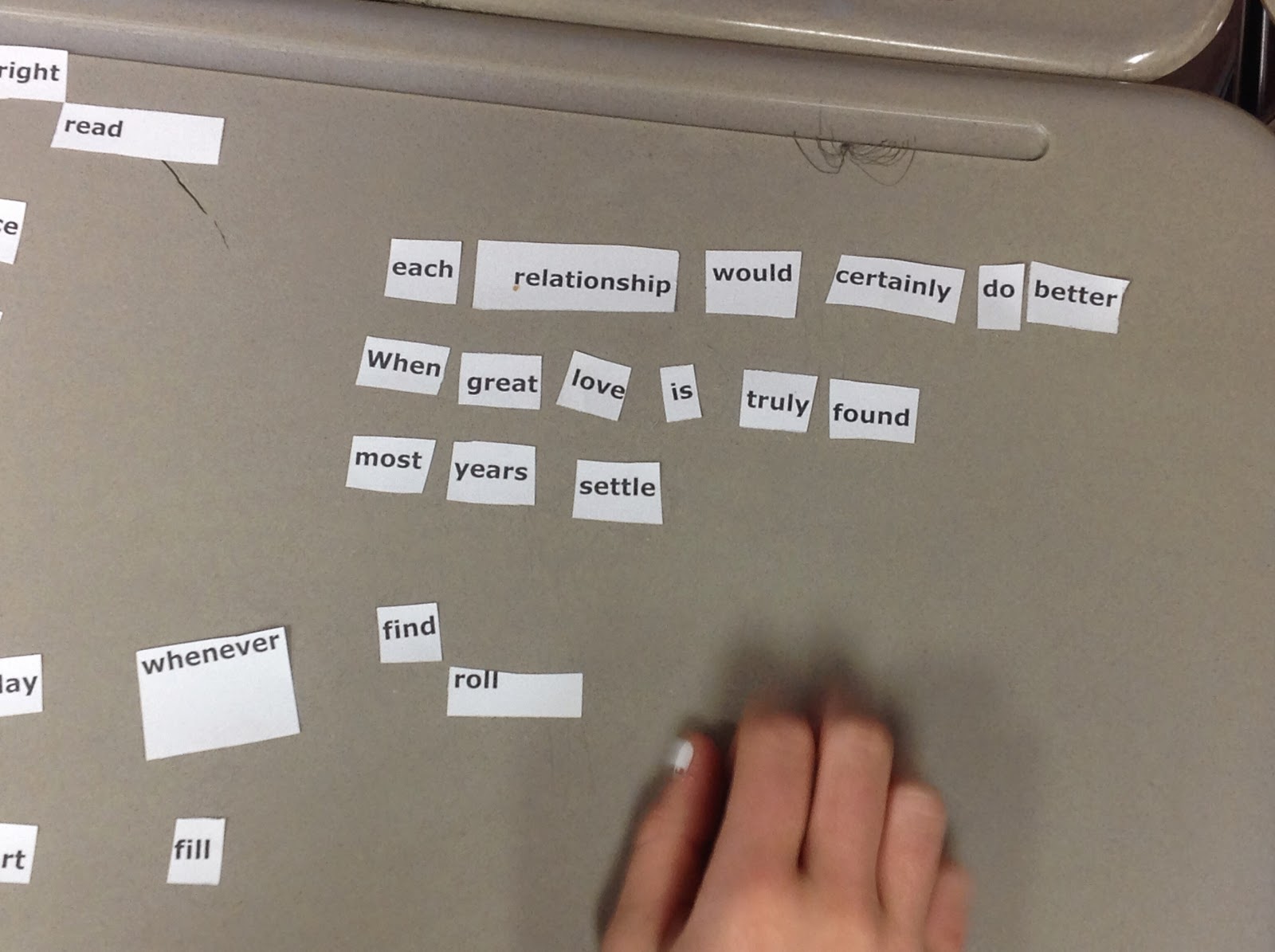
Since reading Steinbeck's Of Mice and Men, my 9th grade students have been focusing on the concept of the American Dream, analyzing companion texts such as Steve Jobs' 2005 Commencement Speech at Stanford University, MLK's I Have a Dream, and Ashton Kutcher's  2013 Teen Choice Award Acceptance Speech. We close read them, answered comprehension questions, and made comparisons with how each text answers the question, "What is the American Dream, and how does one achieve it?" Wanting to provide them with a "fun" (ok English teacher's definition of fun) way to engage with the texts, I divided my students into groups and had them compose original poems from the words a la magnetic poetry. 

I'm sure we all remember the magnetic poetry kits.  I may still have a few hiding in a box somewhere from when we moved to our house four years ago.... Magnetic poetry kits are useful for sparking creativity, but there is no need to rush out to the store (or in my case, tear apart boxes in the attic).

Wordle: MLK I Have  Dream
To create the kits, I copy/pasted each speech into a Google Doc (Word works fine, too), played with the font and size of the text, and deleted common words, then cut the words out by hand and stashing them in their own envelope.  At first I tried creating word clouds of the speeches in Wordle, but the variation of font size and the way in which the words were laid out on the page made it difficult for cutting the words out. I was also running out of time and had to quickly devise a new method when I realized the word cloud wasn't working out as planned.  The Word doc worked fine and I varied the font per speech.

Students got into groups of 3 or 4, making a table top out of their desks. Each group received an unmarked envelope and got to work composing their poems and snapping pictures that were uploaded to our Edmodo class group. It was interesting to see how students initially maintained a linear structure for their unmagnetic poems, and it took prompting by me to try out other formations.

Towards the end of the period, I reconvened the class and we discussed their artistic choices and if they recognized the original text. Students easily figured out which speech was which, and we had a lively discussion about diction and theme.

Check out some of their poems below:


Senin, 16 Februari 2015

Mentor Texts & Writing

Recently, during my English department meeting, we discussed ways to incorporate more nonfiction writing, especially writing that is research based, in our classrooms. Many of us agree that the 8 week research paper unit in which skills are taught in isolation to the rest of the curriculum is not an effective strategy, and while I've done well with integrating research skills into daily tasks, I know my students are still weak at pulling it all together into a cohesive writing piece.

In the beginning of the school year, I introduced my students to Joseph Campbell's Hero Journey concept and used the short stories read in class as mentor texts for fiction writing.  Rather than having my students write an original hero journey story (which would be a novel!), students drew a plot diagram for an original concept of a story and wrote one scene as if ripped from the pages of a book.  The students attempted to emulate the writing techniques of Richard Connell, Edgar Allan Poe, and Richard Peck in their original stories.  Using the short stories as mentor texts provided my students with models of effective writing techniques and the entire project was a success!  You can read some of their stories here, which we published on a website.

The mentor text strategy worked so well for fiction-based writing that I thought, "why not use this same strategy for nonfiction writing?" Students can read nonfiction pieces from acclaimed authors, identify the writing techniques used, and then write a nonfiction piece attempting to use the same techniques.  Sounds good, right?  Ok, well this is where I need YOUR HELP.

I think using mentor texts is a very viable strategy, but I don't know where to start!  There are so many texts to choose from!  I started this collaborative Google Doc in the hope that we can crowdsource some ideas for using mentor texts for nonfiction writing.  PLEASE, oh PLEASE, click on this link and add your resources, texts, and writing task ideas to this page. You can view the document below.

THANK YOU!


Senin, 26 Januari 2015

#FlipClassFlashBlog 3: Late Work Policies

I allow my students to turn in work late.  I don't take points off, but I do have a conversation with the student about why the assignment is late. Sometimes I get a litany of excuses, but other times I learn about my students as people rather than scores in a gradebook.

My students who choose to open up know that I care about their overall wellbeing. Talking with "Stella," I learned that she is working extra shifts after school to help out her family after the death of her aunt.  Stella turns her work in when she can, sometimes meeting my due dates, but most often not.  In the grand scheme of things, "Stella" helping her family is more important than completing my active reading assignment, but I also recognize that there is a fine line between legitimate prioritizing and procrastination-- I have to be very careful that I am not enabling my students' procrastination and reinforcing bad habits that will carry into adulthood.

Trying to strike a balance, I give my students choice: rather than a specific due date, students can choose within a window of dates for turning in specific assignments.  Will I take the late assignment even after the window closes? Probably, but not without a sit-down discussion with the student.  I really like Shai McGowan's policy of having students including a cover letter with the late assignment:


I may try implementing this next year. Here is the current policy as stated in my class expectations:


  • All Paper-Based assignments are due IN CLASS on the specified due date.
  • All online assignments are given a 2 day window for turning in the work that is to be submitted via Edmodo.  For online assignments ONLY, there is a 2-day window. All online assignments are due by 11:59 pm on the last day of the window period.  This two day window allows students to schedule their time accordingly and make adjustments in the event of issues.

Paper-based assignments are due on a specific date because we will be using the assignment as part of a class or group activity.  I'm more flexible with online due dates because I most likely will not have time to score it until a few days (or more) after the window closes.


The due date window attempts to encourage students to make choices within a reasonable boundary.  For the most, my students are able to complete assignments within the window.  When it all comes down to accepting late assignments, the question teachers must ask themselves is, "What is more important: the student be obedient or understanding why the work is late?"

Senin, 19 Januari 2015

#FlipclassFlashBlog 2: Classroom Hacks

The #flipclass chat on Monday nights is my favorite chat for a number of reasons.  One, this was the first chat I found when I enter the twittersphere and, two, #flipclass is always pushing my learning in new directions-- great people and great topics always keep me thinking.  Tonight, we are doing another flash blog post:  chat for 20 mins, compose blog post for 20 mins, and then share with the #flipclass folks for 20 mins. The topic for tonight is classroom hacks.

"Hacking" the multiple choice/true-false quiz, Edmodo's quiz feature is my go-to tool for replacing paper quizzes and scantron forms and providing instantaneous feedback on student performance.  Edmodo's quizzes have saved me so much time grading.  For tips and tricks, check out this post.  Edmodo's overall platform has done so much to move my classroom into the 21st Century and beyond.

Helping my students become better readers, Curriculet is my choice for a digital reading platform.  As with other digital tools, Curriculet provides instantaneous feedback on student performance and allows me to be there with my students as they are reading.  The annotations and questions embedded in the text are MY annotations and questions-- not some canned curriculum devised by a company that may or may not have seen the inside of a classroom. Curriculet is build by teachers for teachers-- they are an amazing company driving the digital reading evolution. Whether you use Curriculet to flip novel reading (I did it with Romeo & Juliet  and A Tale of Two Cities!!!) or for short reading assignments, you will love Curriculet as much as I do.

Aside from digital tools, one of my favorite lessons for the day before break or needing a filler between units is doing a card shower for alumni serving in the military.  A few years back, I asked the principal's professional assistant for a list of alumni serving in the military and any mailing addresses available.  I kept a master list and stock piled craft supplies (cardstock, construction paper, glue sticks, markers, glitter, etc).  On the day of the actual card shower, students were given the task to create a card for as many folks as possible on the list.  I then bundled each together in a large envelope (or more per alumni) and dropped them in the mail.  Usually we do this around holiday time so we can use a holiday theme.  My students learn informal letter writing and the alumni get a nice surprise in the mail.  Every now and then, I get to hear back from the alumni.


I Have a Dream....

While I am not nearly as gifted as an orator or leader on a national scale, in the spirit of Dr. Martin Luther King Jr. Day, I've listed some of my educational dreams...


I have a dream that one day America's students will free from the tyranny of high stakes testing, able to learn and showcase their prowess in any way they choose.

I have a dream that classrooms will be student-centered with all students engaged in learning activities that are relevant and promote higher-level thinking.

I have a dream of working with students in small groups and one-on-one without time or curricular constraints, that students will want to learn from their teachers in a collegial and collaborative manner without focusing on points or grades.

I have a dream that all classrooms will be provided with resources and tools regardless of budgets or demographics, that classrooms will be comfortable and engaging learning environments without desks situated in linear rows.

I have a dream that students will be knowledgable and appropriate digital citizens so that classrooms across the country and world will be connected, sharing their learning experiences.


I have so many dreams for myself, my students, classroom, colleagues, and beyond, but I feel that dreams of today's educators are being squashed by forces beyond our control.  How can we achieve our educational dreams when testing dictates schedules, access to resources, and curriculum?  How can my students achieve their dreams when they are pulled in so many directions?  I don't have the answers, but I can do anything and everything in my power to guide all towards a better education.

What are your dreams?


A big thank you to Sylvia Duckworth who made a #sketchnote out of this blog post. So cool! 

Class Dojo: All About Relationships with the New App

I am continually impressed with Class Dojo's ability to meet the needs of educators. Striving to keep all stakeholders informed on students' performance in the classroom, Class Dojo uses behaviorist techniques and positive reinforcement to track student behavior and provide real-time data for parents (and students).  Whether teachers use Class Dojo all the time or during specific class activities, Class Dojo is the only app for better classroom management.

In case you missed it, last week Class Dojo announced that they have redesigned the Class Dojo app.

From the horse's mouth, here is the update announcement:


Senin, 12 Januari 2015

Don't Let Your Birkenstocks Get Moldy

So I'm sure you've seen those cable versus satellite commercials-- yeah, those ones with the crazy trains of logic.  Here's one about lowland Gorillas...


Despite the crazy logic, there is sense in this, and I've had my own epiphany this school year.

If you haven't noticed (or maybe you have), there has been quite a lag in the number of blog posts I've written since this summer.  My teaching schedule is a tough one. I teach in 2 buildings, 3 different preps in 3 different classrooms.  Every time a bell rings, I must move to somewhere else because another teacher's class is coming in to the room. I embody my "Go! Go! Go!" mantra. I can barely keep things straight and I am only able to do 1/10th of what I normally do: Brody stays home, desks remain in 5 rows facing front, classrooms are not decorated with student work, blog posts are unwritten. But aside from what I'm not able to do, I've realized that I've forgotten tricks that I learned in my first few years of teaching when I last travelled. I became comfortable and complacent having my own classroom space for 10+ years of the 16 years of my career-- sure, I shared rooms with other teachers during that time, but it was still "my room" that the other teacher was entering. Now, I'm a stranger in a strangeland, and I'm having so much trouble teaching in spaces that are not "mine".   Despite the craziness of the schedule, it has forced me to me out & about more, connecting to colleagues I haven't seen often.

So, what does all of this have to do with moldy Birkenstocks?

Well, I digging in my closet the other day looking for shoes and I came across my much worn, beloved Birkenstocks that I haven't worn in far too long. The miles I've walked in those shoes... only to be buried in the closet, and, to my shock and horror, the cork footbed had a layer of dusty green-grey mold. How could I have neglected the Birkenstocks that walked me to where I am today?

My Birkenstocks are a symbol, reminding me to not forget to be ingenious, free spirited, and well-travelled.

So in the spirit of Direct TV's logical advertising campaign...

When you occupy a classroom too long you get comfortable.
When you get comfortable, you forget the things you learned.
When you forget the things you learned, you stop wearing traveling shoes.
When you stop wearing traveling shoes, they get moldy. 
Don't let your Birkenstocks get moldy.
Get out of your classrooms and keep learning.


Selasa, 16 Desember 2014

Giving Voices to Stars

In case you missed in my myriad of tweets every Monday Night and Tuesday morning for the past few months, my former student, Matt McAndrew, has been a contestant on NBC's The Voice. Every Monday at school has been, "Matt McAndrew Monday!" and every Tuesday, students take out their phones as part of their Do Now to Vote for Matt. I am over the moon and so enthralled with Matt's performances.


I can't stop listening to Matt's duet with Adam Levine, "Lost Stars" nor reflecting on this whole crazy Matt McAndrew & The Voice craziness. Playing this video for my students today in room 5-1, I pointed at the spot where Matt used to sit in class and pointed at the screen showing Matt singing with Adam Levine. 


I am in awe and humbled as an educator. I cannot predict what my students will become. And sometimes, on a rare occasion, there is a glimmer where I can see the girl or "boy caught up in dreams and fantasies reaching for someone" he/she will be. But never would I have predicted what Matt has accomplished the past few months. Now, that doesn't mean I didn't believe he could do it... that means I didn't see it coming. I didn't recognize the glimmer or "lost star" back in 2005; I was too caught up then in the assignments & grades & rigor of education.


Thank you, Matt, for this gift of sharing your talent with all of us, for reminding me to look for the glimmer and the "lost stars". All I can do is be a teacher on a daily basis who will give students the skills and support to do whatever they want to do whenever they find their calling. No test score or homework assignment will ever determine the worth of the students in class. Thank you to all the Southern Regional High School (and everywhere in the world) teachers who shine for our students.


Regardless of tonight's outcome, Matt McAndrew is a star.

Rabu, 05 November 2014

Connecting with Authors via Social Media

While many will vilify social media and focus only on the posts where folks are acting inappropriately or unprofessionally, social media is very powerful tool for connecting regular ol' folks like you and me with experts in a field.  I use Facebook to share photos of my girls with family who live elsewhere and to keep up to date on what some of my favorite authors are up to.  I've had a guest post by author MJ Fletcher, and I've written before about connecting with Shakespearean actor/director and author David Blixt via Facebook and this week I had the opportunity to converse briefly with Diana Gabaldon.

Diana Gabaldon's Outlander series is at the top of my must-read list if you like historical fiction/sci-fi/fantasy/timetravel books. Her work is really knows no bounds of genre, and it so wonderfully well researched and written. Much to the delight of her fans, Gabaldon's novels have recently been turned in to a TV show on the Starz network sparking a whole series of blogs and websites dedicated to all things Outlandish which Gabaldon frequently shares the links to such sites via Facebook. One such site, Outlander Anatomy, is a fascinating read about the science of anatomy using the characters and events in the TV series as inspiration for the posts.  Gabaldon also shares excerpts from her novels and current projects, and she will even share HOW she writes.

As an English teacher, I deconstruct and analyze texts with my students, and often I am (and every English teacher out there is) accused of close reading too far into the text. My students will question, "How do you KNOW that Poe is using irony in "Cask of Amontillado?"  "How do you KNOW Shakespeare intended to invert the gender roles in the balcony scene of Romeo & Juliet?" My defense often involves supporting my opinion with proof from the text and, if available from the author, researched explanations. We also have a discussion about who creates meaning in texts: the writer or the reader? The answer is both.

I also use literature as a means for modeling writing for students.  We examine the techniques used by acclaimed authors and students attempt to use the same technique in their own writing. We examine Richard Peck's use of literary devices and motif in "Priscilla and the Wimps," Poe's use of narration, verbal irony and dialogue in "Cask of Amontillado," and Richard Connell's use of ellipsis and characterization in "The Most Dangerous Game". We analyze each author's style, diction, sentence structure, and I challenge students to attempt using these same techniques in our Create a Hero project. The students draft a profile of a hero they create, map out the storyline following Joseph Campbell's monomyth/hero's journey, and write a scene as if ripped from the pages of a larger novel. Students are now sharing their scenes and talking about the choices they made in crafting the story. So not only have we discussed how an author writes, but the students take on the role as authors and showcase how/why they wrote the scene they way they did.

Thanks to Facebook and the power of social media, I can share with students an example of how one author crafts a story and makes intentional choices when writing.  Take a look at these screenshots of Diana Gabaldon sharing an excerpt from her novel, Written in My Own Heart's Blood, complete with annotations explaining the scene. The original post is much, much longer, so you will have to go to Facebook to read the rest.


And if I didn't think Diana Gabaldon sharing her work was cool enough, she also REPLIED to my comments on her post validating how I teach writing through literature. 


Selasa, 04 November 2014

PBL & Flipped Learning at Home using Rainbow Looms

My daughters are 8 and 6 years old and they have gotten into the Rainbow Loom craze.  In the melee of doing laundry and catching up on stuff during our November break, I realized that flipped, project based learning was going on in my own home. My girls are intrinsically motivated to create their bracelets and often refer to YouTube videos for how to create them. Through the process, my daughters are practicing counting skills, recognizing and following patterns, hand-eye coordination, and organizational skills.  My girls are also demonstrating search and evaluation skills as they scour YouTube for videos that work well for them to follow, and (thank heavens) interpersonal skills as they work together.

This got me wondering about how the Rainbow Loom craze could be brought into the classroom. Not only could students work on all of the skills (and more) that I mention above, but they also could practice writing skills creating how-to manuals and digital literacy skills by creating their own video tutorials. I would love to read/hear/see if/how folks are incorporating Rainbow Looms into their classes.

I just snapped pictures of my girls, and my 6 year old first-grade daughter counting her pink bands and laying them out in pairs, declaring, "I'm counting by twos!"


Look closely for the pairs of pink bands laid out on the carpet and don't mind Charlie's photobomb.


Sabtu, 01 November 2014

Flipped Learning Podcast: Tools for Assessment

I had a great conversation with Troy Cockrum and Joan Brown about tech tools for assessment on the Flipped Learning Network's Podcast. I look at edtech as a vehicle for learning and a way to leverage the workload for teachers.

Check out the conversation:


Jumat, 31 Oktober 2014

In the Teacher's Lounge: Using Edmodo to Teach Digital Literacy

I had the pleasure on Tuesday last week to give a webinar on how I use Edmodo to teach my students digital literacy skills and help prepare them for digital assessments.  My students piloted the PARCC last Spring and it became clear that knowing how to effectively navigate through a website will impact student scores on the Common Core assessment.  Not only are my students being assessed on reading and writing literacy skills, but they are also being evaluated on understanding how to navigate and use a website.

Watch the webinar to see what I do and how I do it.


Here is a copy of my Google Slides so that you can access the resources linked in the presentation. There are lots of Easter eggs hidden in the slides, so use your digital literacy skills and explore!


Interested in crowd-sourcing a catalog of digital tools that target specific skills? Add your favorite tools here!


Kamis, 30 Oktober 2014

#ECET2NOLA Starting

I can't stop thinking about the Elevating and Celebrating Effective Teaching & Teachers conference that I attended last weekend. I keep thinking about the notions of leadership and being a change agent as I reflect on how I got to attend such an inspiring event.

I'd like to say it started on the plane on the way to New Orleans and #ECET2NOLA, but it started before that.  It started before we were at the gate waiting to board the plane. It started before the invitation to #ECET2NOLA. It even started before #NJPAECET2 where we met face to face after months of planning and prepping for the regional conference. I keep thinking (read: obsessing) about how I got to this point, and I realized after lengthy discussions and quick interactions with others, I've been asking the wrong question all along.

It is not about "when" or "where;"  it is about "who."

Every moments begins with someone that incites it. I keep thinking about how ECET2 as an organization got started. What was the chain of interactions; what was the inciting incident? I need to do some research.  And as I've been desconstructing and mulling all of this over while walking through the halls of my school with my thoughts being interrupted by greetings from present and former students, I realized that the inciting incident begins with the smallest of gestures.  What starts the interaction between two people that leads to more interactions that eventually escalates and expands into a conference? It is one word, "Hi." It is the courage to say one word, "Hi."


PD on a Plane

At the gate, seven of us make introductions and realize that we have been brought together by one person who had the courage to say hi to us on Twitter, at TeachMeetNJ, at NJPAECET2... Barry.  One might think there would be awkwardness or that tap-dance of give-take getting to know one another, but it was so natural and energizing. 

Fast forward to the embarking on the plane, finding seats, scrambling for overhead space, and then begins the hat dance of "will you trade seats with me?"  Moving so a husband and wife can sit closer together, I end up 5 rows back in an aisle seat next to a young woman in the window seat and across the aisle from two others in our #ECET2NOLA party. Our conversations at the gate spill over to the aisle of the plane. The three of us, Scott C., Ryan, and myself, chat about educational issues until I hear from the window seat, "Excuse me, I overhear you are teachers.... I am a teacher, too..."

What was scheduled to be a three hour flight becomes a three hour mini-conference on the plane. From a keynote address in the aisles to break out sessions about flipping and being an administrator, we talked about best practices and how to problem solve specific classroom issues. Christina, my window seat companion, thanked us profusely about how helpful the conversation was was for figuring out how to increase student engagement and ensure students are performing in her class. She even went on to say, "Thank you so much. You have no idea what you have done for me."  I replied, "Yes, I do know because someone did the same for me years ago."


Saying HI Matters

In year 12 of my teaching career four years ago, I experienced a crisis. Struggling with being a wife, mom, coach, and teacher, I was lacking a sense of community and a way to manage it all. I needed a new way of doing things and people that would lift me up. Poking around on Twitter and local conferences, I connected with Cheryl, Andrew, Karl, and Liz.  Without these people, I would not be where I am today.  I am grateful for the opportunity to pay it forward with Christina. 

The courage to say HI and engage in a conversation opens a door to a space that was not known prior. We can't get to new places if we aren't willing to start the process. And starting the process begins with the most simplest gesture of making a connection to someone else: make eye contact and say hi.

When I build relationships with new classes each year, I make sure I learn my students' names as fast as I can, and then outside of the classroom, I make sure that during the change of class that I say hi to my students in the hall.  Not only does it give me practice recognizing their names and faces in various contexts, but saying HI in the halls lets my students know in the simplest terms that I care about them and see them as people. When I first start saying Hi in the halls, I was the one to say HI first and some students would try to walk past me and not make eye contact. I will lean towards them or step in their way so they are forced to look up, see my smiling face and hear me say hi. And when I say hi, I am energetic and exuberant, showing my happiness at having "run into" the students in the hall. Now two months into the school year, both former and "new" students are saying hi to me first before I say hi to them. They know I care because I say HI, and I know they care because they say HI to me. 

If you want to elevate yourself or your students, start with saying HI. 

It isn't about when it started.
It isn't about where it started.

It is about WHO started it.


Be the person who starts the chain reaction.  Be the person who says HI to colleagues and students in the hall.  Be the person who joins a community of educators. Be the person recognizes the greatest in others.


Sabtu, 25 Oktober 2014

#ECET2NOLA I see what you did there....

I see what you did there....

On the plane, chatting with folks around you around.  Keynoting in the aisles and igniting learning in others who are struggling.  But did you see, that you gave me a chance to pay it forward?

In the session, tying Seinfeld to blogging...."Seinfeld is not a show about nothing and your blog is not a blog about nothing."

It is not about me it is about YOU.