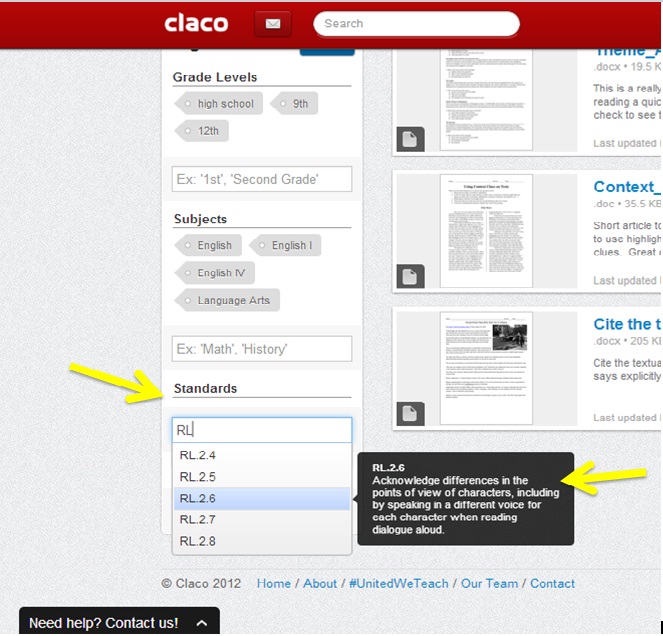
Claco (in Beta right now, but you can request an invite) provides a place for educators to store all their resources including files, bookmarks, websites, videos and just about any other content imaginable in organized and tagged online binders. Claco also allows for easy sharing with other educators, parents, and teachers with the ability to "snap" binders and files from other Claco users or share via Facebook, Twitter, or Pinterest. While the organization and sharing are the foundations of Claco, there are additional features and the "what is to come" that make Claco stand out on the web.
The organizational and sharing aspects of Claco are excellent. In my previously paper-based classroom, I had shelves with 3 ring binders of each unit and novels studied, and file folders of resources stashed (ok, crammed) in filing cabinets. Claco mimics this design by streamlining the binder and file folder features in the Claco cloud. No longer do I need to worry about lending out binders hoping they get returned in pristine condition or running to the copier to share resources with my colleagues, since with one click I can determine if resources, for example Short Stories, are public or private. It is now the responsibility of others to "snap" my resources to their own binders (and mine to snap their's) and I don't ever have to worry about collecting the lent out materials or remembering where I put my colleague's materials. The tagging feature is one of my favorites. Resources can be tagged by grade level, subjects, Common Core Standards (YES, Common Core Standards!), and keywords. Having the Common Core Standards already embedded is a major selling point for me. I do not have to look up the numbers or copy/paste the standards into my own plans. This feature is vital for saving time writing lesson plans online. The "What is to Come" has me very intrigued: According to Jordan Hamel (@JordanHamel), member of Team Claco, "We will have real-time lesson plan collaboration, and lesson building on Claco." Jordan also puts it best with articulating the goals of Claco, "We are creating a place where educators can build, share and store class curricula, but also a community of educators that will share and learn together." Team building and organization are vital in the online world of education, and Team Claco can help educators become connected. Claco promotes a positive networking environment that extends beyond the walls of one's own school building: teachers from across the country and world can share resources. #UnitedWeTeach
With the new school year barely a month old, assessments and goals have been in the foreground of my educational schema: beginning the year with multiple days of diagnostic assessments and trying to figure out how to authentically assess my students and manage the use of technology, I'm constantly thinking about where are we headed and how will we get there. I've started off the year with Edmodo and using a flipped process from day one (ok, really day 4 after mandatory diagnostic testing). I have a general game plan in mind that I am constantly tweaking. I will say it is invigorating to explore the technological landscape and figuring out how to do what we've done in past years in a new tech-y and paperless way (just read my "soon" to be written post about The Most Wonderful First 1:1 Week).
Thinking about assessments, I came across this video on Edutopia.
The video, "Strategic Goals: Formative Plus Summative Assessment Equals Rigor," highlights NY's School of the Future use of thought-provoking authentic assessments to promote student performance. The students work on drafting and revising projects and papers to create an 8-10 page (minimum) Exhibition at the end of the school year. Teachers assess students on the formative process throughout the year, culminating in the final summative Exhibition. Some 9th grade students even wrote 15-20 page papers on controversial topics-- that is simply astounding.
What I like about SOF's Exhibition:
Goal oriented
Personalized
Strategic
Authentic use of higher level thinking
Process oriented
Cross-curricular
I also like that the Exhibition is not a standardized test and that it is a project that pushes the students to achieve lofty academic goals.
While I do not use the Habits of the Mind on such a grand summative project as the teachers and students at SOF, I do constantly promote the use of critical thinking skills everyday in my classroom. "But what if we....?"
I identify with the tenets of flipped approached and find that it is a natural fit for much of what I do in my student-centered, collaborative learning environment. A hybrid-mastery approach works well for my style, but I cannot be completely asynchronous for a number of reasons both curricular and logistical.
Flipping English is about two things: 1) helping students take responsibility for their own learning by understanding them and their unique skills, abilities, and needs, and 2) leveraging technology to build a student-centred learning environment that meaningfully engages the cultural context in which our students live.
#1 is relatively easy to do with student-centered learning. The teacher is the conductor on the train of learning.
#2 can seem daunting when thinking that in order to flip the teacher has to be connected to the internet, has the ability to make effective videos, and has a way for videos to be available to students. But it is NOT daunting when you, the teacher, take what you have done in a traditional manner on paper and apply the flip process. You do NOT need videos! The flip is not the video; the flip is in the PROCESS of HOW the students learn, not WHAT they learn from!
This week, using a flipped approach, I introduced to my students to testing strategies that align with NJ's HSPA standardized test (Take a look at this Post on testing in NJ). My 9th grade colleagues and I teach the testing strategies in context with the literature taught in class. We do not teach exclusively to the test, nor can we ignore the test. Instead, we show the students strategies that can be transferred to any standardized test. The NJ Department of Ed states that this year's sophmores will be the last group to take the HSPA, but without a clear plan from the state (lots of mentions of EOC's and PARCC's), I am fearful of completely forgoing teaching testing skills. Something is coming, and I'd like the students to have some semblance of preparation.
Traditionally, I've given a PowerPoint presentation on how to mark up prompts and questions using the Circle & RUN strategy and an additional PPT on how to write an open-ended response. The students copy down the notes, then they are drilled until they get it right (ie. conform), and then through out the year, we reinforce the skills to maintain proficiency. Students take diagnostic tests in 9th & 10th grade to prepare for the real State test in 11th grade.While this approach has worked-- our HSPA language arts scores show a 98.4% passing rate for general education students-- it requires the teacher to determine proficiency and maintain the skill set.
Using a flipped approach for introducing and initial practicing of HSPA skills, activities were group and inquiry oriented. Students became detectives for figuring out the meaning of the strategies and how to apply them.
The Process:
At home, students viewed a quick video on using the Circle-RUN strategy that I posted on Edmodo. I just used a PPT I had and made my very first screencast using Screencast-O-Matic. The hardest part was keeping my girls (ages 4.5 & 6) quiet for 2 mins to record the video-- you'll hear when I try shouting over them. Students took notes on the video and marked up practice questions which I checked the next day.
The next day in class, students were sat in groups of their choosing. They were given a paper copy of the RACES PPT presentation instead of listening to me lecture. (Google doesn't like the formatting of my PPT, but you get the idea) Students were also given a sample scored Open-Ended question with multiple sample scored answers that aligned with steps on the rubric. All papers were hole punched for inclusion in their 3-ring binders. I gave general directions ("Figure out what the meaning of this "stuff" and what are you supposed to do?") and while students worked, I circulated around the group asking guiding questions as needed. Any of their questions were answered with an additional question from me. I did not give them answers.
Next day in class (today-Friday), I gave them an Open-Ended question and with minimal directions said: use your resources to answer the question and earn a score of 4 on the rubric. Student responses were not collected.
Next day in class (this coming Monday), and still in groups, students will revise a sample answer. Students will then self-assess their own open-ended responses from Friday and make any changes as needed.
Students will do their first structured peer editing and evaluate each other's open ended responses.
As far as leveraging technology, I did not use videos for most of the flip, and in this case, it was mostly paper copies of notes and presentation slides. I'm new to the whole video creation process, so most of my flipping will be done without videos for now. The students were engaged in the process and had to be responsible for their own understanding of the strategies. Students used collaborative thinking skills to help guide each other in the direction of their understanding. Listening to their group conversations and asking questions to formatively assess their understanding, it was evident that the students "got it." There still needs to be further summative assessments, but at least the students weren't drilled to death in the process.
Week 2 Break Down: 1. Narrative Terms & Literary Devices 2. Collaborative Google Docs 3. Socrative Space Race 4. Seniors vs Freshmen
"Bouquet of Sunflowers" by Claude Monet Oil on Canvas, 1881
"Flower"by Katherine Baker, Microsoft Paint, 2012
With the freshmen, I start the year off working with Narrative Terms and showing how an author can add artistry to writing. This is akin to at home finger painting versus museum quality artwork: I can fingerpaint a picture of a flower, but an artist can enhance the picture of the flower by using artistic techniques-- brushstrokes, type of paint, shading, etc. Both are artistic in their own sense, but I doubt you'll see my fingerpainting hung in the Museum of Modern Art. Likewise in writing, a person can write a simple sentence about a flower, but an author can add depth and meaning by using literary devices.
The flower bloomed in the spring. -K. Baker
Like the lily,That once was mistress of the field and flourish'd, I'll hang my head and perish. - William Shakespeare, Henry VIII (3.1.168-70)
There is the use of consonance of the "L, "S" and "D" sounds, alliteration of the "F" and "H" sounds, as well as the use of meter and simile in Shakespeare's sentence. I may be a decent English teacher, but I am certainly not published like Shakespeare! So this is what my freshmen students did one day this week. We read the short story, "Priscilla and the Wimps" by Richard Peck and then used a collaborative Google Doc to mark up the text as a class. After identifying the literary devices in the text, students were then directed to another Googe Doc for collaboratively answering analysis questions and writing a group paragraph response. The focus with this activity is on the PROCESS. I wanted to "formatively" assess their understanding and ability to collaborate. I was not expecting students to be able to give me a final product in one class period. Since I am not a 1:1 district, I had to sign out the computer lab and since many students use technology for entertainment purposes, this was their first exposure to Google Docs and the collaborative process. At the conclusion of the activity, students were directed to a Google Form on which they relfected on the process. Observations:
The students enjoyed working together, but the students did not like working together on such a large scale. Too many students on the same document made it lag and some students deleted/undid other students' submissions. I figured this would happen, but I wanted them to understand the process. I wanted them to make mistakes so that when I put them in small collaborative groups, they will make fewer mistakes and I will get a final finished product from the group.
The students had some trouble applying their knowledge of the terms-- probably because they still needed to obtain the knowledge. They could pick out obvious narrative terms (simile, alliteration) but had trouble with irony and diction.
While they could "search & locate" narrative terms and input their individual responses on the group questions, students struggled with writing collaboratively. They could not create a group paragraph answer in the time given. I didn't expect them to complete the paragraph, but I wanted to give them the opportunity to exceed my expectations.
The next day in class (Friday), we reviewed the collaborative document and went over some of the errors and missed terms. We discussed how an author can build a story around an allusion, in this case the Garden of Eden, and use narrative terms to enhance the story. I saw light bulbs going off when they made the connections! We also went over how to make the collaborative process easier. To finish off the class period, the students used their personal devices to work in groups on a 5 minute Socrative Space Race. Despite some hiccups with connecting to the wi-fi and getting the students acclimated, the race was a success: students were animated, on task, and used teamwork to finish the race. I'm also checking out Infuse Learning and Naiku's Quick Question to add to my arsenal of clicker-type activities using personal devices. Where do we go from here? We will continue to work on identifying and analyzing narrative terms/literary devices throughout the year. I'll be giving them a test on narrative terms at the end of this week, as well as a quiz on "Priscilla & the Wimps" to assess their knowledge and comprehension. In addition, we'll be doing more collaborative writing using a flipped and mastery approach. I will be assigning the same group questions again, but this time the groups will be student chosen and each group will receive their own GDoc to complete the writing task. A Little More on Flipped & Mastery Writing The only way for the students to become better writers is to write, but I need them to be thinking about their writing while doing it, and I can't have them waiting for me to give them back their papers covered in red ink. So, if they write with partners or groups, they should be able to edit and make choices while in the group process. This should increase the frequency of feedback from each other and me since I can "drop in" on the collaborative Gdocs or look over the shoulder when writing on paper and they can talk to each other about the choices they are making. I can increase the number of formative writing tasks (notice I did not say assignment!), and decrease the number (but increase the quality) of summative assignments. This will also take the pressure off of students and hopefully they won't procrastinate writing in general. I have been so tired of doing writing the traditional way and getting poor quality final essays. Writing is a process, so why should I only focus on the final product. It doesn't make sense! Any additional ideas on writing? Seniors vs. Freshmen For the first time in my 14 year career, I'm teaching one section of senior general level English. I'm enjoying the class, but I'm concerned. While the seniors are agreeable and behaved, they have also been well-trained in the traditional mode: they love listening to me talk and tell them answers. This is great if I were a traditional type teacher-- but as you can guess from my blog, I'm not. We did a version of the collaborative Google Doc, but it was focused on finding answers to a web quest on Beowulf. It was not as involved of a lesson as the freshmen. While it is nice to not have to deal with behavior issues and the traditional model here would be soooooo easy to implement, I still want the students to think for themselves-- and frankly, I'd get bored with the traditional method. I like flipping, using cooperative learning, and meta-cognition. My initial focus this year with the seniors will be to connect the literature to the students' lives, showing them how the concepts are universal and to apply that knowledge to making decisions out in the real world. I can try to un-train them from the traditional model, but I'm concerned that there won't be much time for reprogramming. Any thoughts or advice on teaching seniors?